A film I put together to go with Mose Allison's great song "Young Man", cause I'm a young man, sort of. Is 41 still young?

Sunday, August 14, 2011


Saturday, August 13, 2011
Apocalypse Over Hiroshima...
 |
| Hiroshima Watch stopped at the moment of the atomic bomb blast |
Those further away from the epicenter of the blast reported a noiseless flash off pure white light. The flash was so intense, the pattern of women's summer dresses where burned onto their skin, macabre tattoos. The burns sustained were horrifying beyond belief, skin burned black and sloughed off. People reported seeing dead butterflies floating to earth in flames and the outlines of bodies scorched onto paving stones.
After the initial blast a second wave of destruction spread from the epicenter destroying almost everything in it's path, this was followed by a devastating fire storm. Black rain fell from the sky, composed of ash and smoke sucked up into the huge mushroom cloud. People, desperate for water drank this radioactive rain. Days later many died as a direct result of drinking this poison rain.
Soon after the initial bombing, people started to display symptoms of radiation sickness; hair loss, vomiting, massive internal hemorrhaging, necrosis, profuse bleeding from wounds, that could not be abated and eventually death.
The American's chose Hiroshima for a reason. It had been left intact, unlike 67 other Japanese cities that had been fire bombed into ashes, and so would serve as a living laboratory, a chance to study the effects of the Atom bomb on buildings and people. The people of Hiroshima would serve as the guinea pigs in this experiment in mass destruction. Even the American scientists were not prepared for the utter devastation not only of the blast itself but of the radiation sickness that followed. Robert Oppenheimer, one of the physicists that worked on the A - Bomb project was quoted as saying later, "Now I have become death, the destroyer of worlds". He would go on to campaign against the use of Atomic weapons and against the post war escalation of nuclear weapons.
The reasons given for the use of the Atomic bomb were said to avoid an inevitable invasion of the Japanese mainland by the allied forces. True, the Japanese leaders seemed hell bent on self sacrifice rather than surrender, expecting every man woman and child to die defending the honour of the Japanese nation. But would this really have happened? Japan was a nation on the brink of starvation, some reported not having had white rive in over a year. It's people were tired and and broken by an un-winnable war. Germany, Japan's main ally had already surrendered, Russia had declared war on Japan and were preparing for an invasion. It's impossible to say what the outcome of an invasion of the Japanese would have wrought, but the estimate at the time of millions of allied troops being killed in hindsight sounds like an over exaggeration, and so the debate continues on the reason for the use of the A-Bomb. After the bombing of Hiroshima, the Japanese high command refused to the terms of surrender proposed by the allies, and on August the 9th. a second atomic bomb was dropped on Nagasaki. Although the devastation was nothing like that off the Hiroshima bombing, 50,000 people still lost their lives.
The final death total is estimated in the region of a quarter of a million people, most of them civilians. For this alone, the bombings of both Hiroshima and Nagasaki remain a reminder of the real cost of war. Memorials remind us of the suffering and inevitable futility of war in all it's guises, for in war there are no victors.
For further reading, go to John Hersey's book "Hiroshima"
Friday, August 12, 2011
Self Harm/Cutting/Scarification...
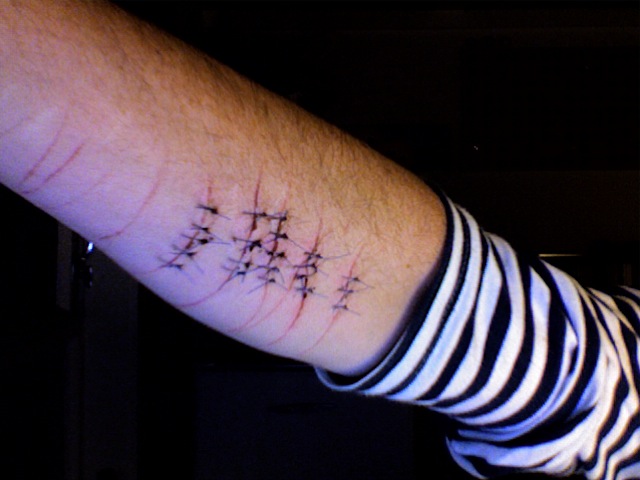
On the surface of it, to any sane and normal person, the thought of taking a knife, or a heated piece of metal and mutilating one's own body must seem like madness. Let me assure it is quite the opposite, the very opposite off madness. Madness denotes something that is out of ones own control, being out of control, out of ones mind, other, away from oneself. Self harm/cutting/branding etc is about control and is, in my own experience carried out by people not only in their right mind, but by people controlling not only there minds but their bodies and at times their very lives, for often the other option is suicide, which in itself is also the ultimate act of control over ones own life and body. Let me make a point here, and let me make it clear...I am not in any way glorifying self mutilation, for want of a better term, psychiatrists are still trying to come up with some nicer academic term....and there is nothing heroic or admirable about taking a knife and slicing your own skin, your own muscle, but it is a reality and often it is survival. Like Anorexics who try to control their minds and bodies by controlling the amount of food they will or wont allow themselves to abide, people who self harm control their emotions and their world by the amount of pain they inflict upon themselves. Pain becomes a way of regulating emotions. Anxiety (that pathetic term for what in reality is living hell), deep depression, suicidal thoughts, all these are stroked away and dispelled with a swift self inflicted wound. It sounds insane, but it makes perfect sense to the person doing it. It is a private, guilty, desperate act...but often it is the one thing that makes the world make sense.
So who does this 'awful' thing. Sad, self pitying Goths? Attention seeking spoiled teenagers (more of this later), anorexic type body conscious want to be skinny models, angry youths, lonely housewives in an out of control world, spoiled rock stars, high flying execs bored of sex and cocaine, normal men and women who have no other outlet for their emotions, priests, nurses, teachers, bus drivers, shop assistants, hard men, soft men, closeted homosexuals, religious fanatics...all of these and more of course. In short normal folk like you and me.
You would be surprised. A word about attention seeking behaviour...after spending a whole weekend cutting myself repeatedly and trying to dress and clean the wounds for the next week, in order that no one else would find out about what I had done to myself, and after my arm had swollen to twice it's size and was obviously badly infected, I reluctantly went to my G.P. for help. I had a fever, was out of my mind with pain and of course was sent to A and E...After a doctor had cleaned and dressed my wounds, and set me aside for "Psychiatric Assessment", a young nurse came to ask some questions...one of the first things she said to me was "Attention seeking at your age....etc" I had nothing to say in reply, I wanted to leave but wasn't allowed as I was deemed a danger to myself. I can see why, but that nurses words were the most damaging thing in the whole episode....
So where does this leave us? Obviously self harm, like any extremes of behaviour needs to be addressed and dealt with. There is lots of help out there and reaching out is always the first step...but like a lot of things in this life, there's more to it than meets the eye, and I wonder about all those 'normal' folks out there who cover themselves in tattoo's and piercings. Is there that much off a difference between all these kinds of behaviours?
We make sense of our lives and emotions in many varied and individual ways. To judge one against the other, the normal as opposed the abnormal? I believe that takes us into the realm of prejudice, ignorance and alienation. I hope that anyone who reads this who is struggling with any kind of emotional dilemma finds the strength to reach out and get the help they deserve. This is not meant to shock in anyway, it's life, and life is sometimes raw and complicated, but that doesn't mean it can't be beautiful and simple in the end...

So who does this 'awful' thing. Sad, self pitying Goths? Attention seeking spoiled teenagers (more of this later), anorexic type body conscious want to be skinny models, angry youths, lonely housewives in an out of control world, spoiled rock stars, high flying execs bored of sex and cocaine, normal men and women who have no other outlet for their emotions, priests, nurses, teachers, bus drivers, shop assistants, hard men, soft men, closeted homosexuals, religious fanatics...all of these and more of course. In short normal folk like you and me.
You would be surprised. A word about attention seeking behaviour...after spending a whole weekend cutting myself repeatedly and trying to dress and clean the wounds for the next week, in order that no one else would find out about what I had done to myself, and after my arm had swollen to twice it's size and was obviously badly infected, I reluctantly went to my G.P. for help. I had a fever, was out of my mind with pain and of course was sent to A and E...After a doctor had cleaned and dressed my wounds, and set me aside for "Psychiatric Assessment", a young nurse came to ask some questions...one of the first things she said to me was "Attention seeking at your age....etc" I had nothing to say in reply, I wanted to leave but wasn't allowed as I was deemed a danger to myself. I can see why, but that nurses words were the most damaging thing in the whole episode....
So where does this leave us? Obviously self harm, like any extremes of behaviour needs to be addressed and dealt with. There is lots of help out there and reaching out is always the first step...but like a lot of things in this life, there's more to it than meets the eye, and I wonder about all those 'normal' folks out there who cover themselves in tattoo's and piercings. Is there that much off a difference between all these kinds of behaviours?
We make sense of our lives and emotions in many varied and individual ways. To judge one against the other, the normal as opposed the abnormal? I believe that takes us into the realm of prejudice, ignorance and alienation. I hope that anyone who reads this who is struggling with any kind of emotional dilemma finds the strength to reach out and get the help they deserve. This is not meant to shock in anyway, it's life, and life is sometimes raw and complicated, but that doesn't mean it can't be beautiful and simple in the end...
Tuesday, July 19, 2011
Oz Covers at Felix Dennis
This truly magnificent collection of OZ magazine covers is a must for the discerning '60's chic radical. They would make great christmas, birthday, christening, bereavement, invitation etc...cards. Send them to your local police constable today and brighten up their day, or just look at them and marvel at the sheer creativity that went into much loved paper of yore...click the link and enjoy the revolution... http://www.felixdennis.com/gallery/oz-covers/


Talking Pictures...It's a kind of Bonzo Dog Band Documentary
Dazzling, surreal, audacious, brave, stupendous, hilarious, frightening, bizarre, goonish, catchy, childish, handsome, ugly, technicolour DADA...a few words to put in a sentence about The Bonzo Dog Band for your English homework. Still Britain's second greatest pop band off all time, and you can take that to the bank, but they wont give you money for it. Don't believe me, watch this rarefied collection of true British eccentricity in full speed ahead action painting, action man, action lights, action cameras, action music... Action. They are The Beatles on laughing gas, I think.

Sunday, March 20, 2011
Sweet Essence of Giraffe...Viv Stanshall at 68
Victor Anthony Stanshall, known as Viv or Vivian for most of his adult life, was born in Shillingford, Oxford on March 21st 1943. The story goes that after his birth the nurse brought three babies into his mothers room, two with small, neat heads and one with a huge head wearing a shock of wild ginger hair. His mother tried for one of the other babies, but there was no getting away from Vivian.
 Viv and his mother lived in Shillingford while her husband, Victor (1909–1990) (a name he had adopted in preference to his own christened name of Vivian), served in the RAF. Vivian wolud later tell his wife, that this was the happiest time of his life. When the war ended, his father returned, and with him the happiness came to an end.The family moved back to Walthamstow. The return of Victor Stanshall was a turning point in the young Vivian's life. With only him and his mother, life was ideal. With the addition of a stern, pretentious father, Stanshall's life took a serious downturn, followed by a further shock at the arrival of a new brother, Mark Stanshall, born in 1949. They were six years apart, an age difference that apparently put a certain amount of emotional distance in their relationship that was never resolved.
As a teenager, Stanshall secretly joined a gang of teddy boys, attracted both by the rock'n'roll and the clothing. Even among such dandies, though, he was a bit of an oddball. About this time, the Stanshall family moved to the Essex coastal town of Leigh-on-Sea. To put aside enough money to get himself through art school (his father having refused to fund such goings-on), Stanshall spent a year in the merchant navy, where he made a very bad waiter, but a great teller of tall tales. He enrolled at the Central School of Art in London. Here, Stanshall and his fellow students, including Rodney Slater, Roger Ruskin Spear and Neil Innes, who was studying art at Goldsmiths College, came together to form a band.
The Bonzo Dog Dooh-Dah Band
The name of the band came from a word game which Stanshall played with art school peer and future Bonzo member Rodney Slater, involving cutting up sentences and juxtaposing the fragments to form new ones. One of the combinations that came out of this exercise was "Bonzo Dog/Dada". The band initially performed under this name, but soon grew tired of explaining what Dada meant. Thus they became the Bonzo Dog Doo-Dah Band — later abbreviated to The Bonzo Dog Band, or just The Bonzos.
In these early days they were a very loose assemblage, consisting of the core members mentioned above, plus just about anyone else who felt like joining in. At times there were as many as 30 of them, with gigs often featuring more people on stage than in the audience. Their act at this time consisted of anarchic re-workings of old British novelty songs, found on 78 rpm records bought from flea markets, spiced with improvisation and a variety of bizarre machines assembled from junk, with at least one explosion per gig.
The Bonzos might have continued in this way, probably disappearing into obscurity, had it not been for a nasty shock: the 1966 chart success of a winsomely arch number called Winchester Cathedral by The New Vaudeville Band — a band comprising session musicians created by songwriter Geoff Stephens, whose musical style was uncannily like the Bonzos' own. As soon as the record became a hit, Stephens and his record company needed a band to present themselves as The New Vaudeville Band. Bob Kerr, a Bonzo member, was asked by his friend Stephens to become the band, and he tried convincing the others that they change their name to achieve greater commercial success, but the advice was rejected...at this point Kerr left the band. Several weeks later, the band appeared on Top Of The Pops performing the songs in clothes exactly like the Bonzos. An emergency meeting was called and the band decided to wear whatever they wanted. The Bonzos realized that if they were to make a mark for themselves, they would have to forge a new path.
According to the band's manager Gerry Bron (brother of the actress Eleanor Bron), Vivian Stanshall was given several weeks to produce songs for the new professional Bonzo Dog Band. When people arrived at his studio they found he had not written a single thing, focusing instead on building a variety of rabbit hutches.
From here on, they started writing their own material and dropping it into the act alongside the old novelty numbers. With Stanshall now liberated from his original role as tuba player and firmly established as the front man, the act became more sophisticated, more daring, satirical, and original. For a while the band existed as a semi-pro outfit playing the college circuit, but it wasn't long before they acquired a manager, went full time, and found themselves booked on the working men's club circuit mainly in the north of England. The band dominated their lives, traveling to low-paying gigs in an old van crammed with any number of musical instruments, an assortment of props, and prop robots.
In 1967, they appeared in The Beatles' Magical Mystery Tour television special playing Vivian's song "Death Cab for Cutie" during the strip club scene, and this was followed by a slot as the house band on Do Not Adjust Your Set, a weekly TV revue show essentially for children, also notable for early appearances by David Jason and various future Monty Pythons.
The Bonzos on "Do Not Adjust Your Set"
In 1968 the Bonzos scored a surprise top ten hit with a number called "I'm the Urban Spaceman" (produced by Apollo C. Vermouth aka Paul McCartney), after management wanted them to "play the game" as Innes put it, to try for a hit single. The band toured incessantly and recorded several albums, which led to a tour of the United States. This was so successful that they were booked for another US tour soon after. Neil Innes remembers that the band were reportedly stopped by a local U.S. sheriff and asked if they were carrying any firearms or drugs. When they denied both, the officer asked how they were going to defend themselves. Vivian piped up from the back of the minibus, "With good manners!"
Between the tours, however, something brought about a change in Stanshall's personality. There were rumours of a bad acid trip in the States, but Vivian never confirmed nor denied this, instead explaining it as a panic on stage which destroyed his confidence and inevitably his life. None of his fellow Bonzos claims to know just what happened, but by the start of the second tour he was taking very large doses of tranquillizers prescribed by a private doctor ostensibly to treat stage-fright, which in reality was crippling agoraphobia and panic disorder. This led also to Vivians increasingly large in take of alcohol in order to self medicate himself for the symptoms of his illness. Nevertheless, the workload never let up. The band had a punishing schedule, often playing more than one gig per evening. The band got sick of the whole touring scene, and decided to split still as friends. In 1970, after six years of mounting exhaustion, they broke up.
The Rawlinson family had been populating Stanshall's imagination for quite a while, their first appearance (in name, at least) being on the Bonzos' 1967 number The Intro & The Outro: "Great to hear the Rawlinsons on trombone".
An LP, "Sir Henry at Rawlinson End", which reworked some of the material from the Peel sessions, appeared in 1978. A sepia-tinted black and white film version, starring Trevor Howard as Sir Henry, and Stanshall as Hubert, followed in 1980. It was also based on the Peel recordings, with many variations from the LP. Some of the film's music was provided by Stanshall's friend Steve Winwood. A book of the same title by Stanshall, illustrated with stills from the film, was published by Eel Pie Publishing in 1980. Nominally a film novelisation, it was distilled from all the various versions of the story, including a good deal of material that was not used in the film.
A second Rawlinson album, "Sir Henry at Ndidi's Kraal" (1983), recounts Sir Henry's disastrous African expedition, but omits the rest of the Rawlinson clan. According to Ki Longfellow-Stanshall, his widow, he regarded this recording as sub-standard and it was released without his knowledge and against his wishes. He was ill when making it, and the record company issued it as quickly as possible. Stanshall was often drunk and/or depressed during production, which took place on The Searchlight, a house boat he bought from Moody Blues and Wings' Denny Laine and moored between Shepperton and Chertsey on the River Thames. He lived on it from 1977 to 1983. Converted from a Second World War era submarine-chaser, it was forever taking on water and sank with all his possessions aboard. Almost all of them were retrieved, some the worse for water damage.
While living on the Searchlight, Stanshall composed and recorded Teddy Boys Don't Knit, and wrote and recorded Sir Henry at Rawlinson End. There, he also wrote and filmed the film of the same name for Tony Stratton-Smith's Charisma Records company. At the same time, he co-wrote with Steve Winwood the songs for Winwood's Arc of a Diver and wrote some of the songs he later used for Stinkfoot, a Comic Opera, the musical comedy he wrote with his second wife Ki Longfellow.
After the Searchlight, the Stanshall family lived and worked on the Thekla, a Baltic Trader, which was sailed 732 nautical miles (1,356 km) from the east coast of England to be moored in the Bristol docks. Ki had bought the Thekla in Sunderland, and converted her into a floating theatre called The Old Profanity Showboat. Vivian joined her when the doors opened to the public for the first time in May 1983. In December 1985, the ship saw the debut of their production, Stinkfoot, a Comic Opera.
Stanshall wrote 27 original songs for Stinkfoot, sharing book and lyric writing with his wife. The show involved bizarre characters that they imagined living under a seaside pier as well as characters taken from Longfellow's early tale for children called Stinkfoot. It proved a success, with people coming from all over Europe and even the Americas to see it. It was revived in London some years later with Peter Moss as musical director, but was not a critical success.
There is also a 28-minute film of Stanshall currently inside the BBC vault: One Man's Week, dated 1975, looks at a week in his life and includes footage of him at The Manor Studio recording studio playing music with Gaspar Lawal, Mongezi Feza, Anthony White and Derek Quinn. This film also shows him talking about his turtles and playing his 'Phonofiddle'.
Stanshall's voice won him several commercial voice-overs, including a campaign for Cadbury's Mini Eggs which involved a reworking of the Bonzos' song Mister Slater's Parrot, under the title of Mister Cadbury's Parrot.
Vivian was married twice: in 1968 to fellow art student Monica Peiser (they had a son, Rupert, that year, and were divorced in 1975); and on 9 September 1980, to novelist Pamela "Ki" Longfellow. They had a daughter, Silky, born on 16 August 1979, named after a racehorse called Silky Sullivan, her mother's childhood favourite.
In late 1988, after Fish had left Marillion, the band considered using lyrics Stanshall had written, but in the end decided to hire John Helmer instead.
In 1989, his short interview with John Wesley Harding was released on Harding's God Made Me Do It: the Christmas EP.
In 1991, Stanshall made a 15-minute autobiographical piece called Vivian Stanshall: The Early Years, aka Crank, for BBC2's The Late Show, in which he confessed to having been terrified of his father, who had always disapproved of him.
A later programme for BBC Radio 4, Vivian Stanshall: Essex Teenager to Renaissance Man (1994) included an interview with his mother in which she insisted that his father had loved him, but Stanshall was mortified that his father had never shown it, not even on his deathbed.


As a teenager, Stanshall secretly joined a gang of teddy boys, attracted both by the rock'n'roll and the clothing. Even among such dandies, though, he was a bit of an oddball. About this time, the Stanshall family moved to the Essex coastal town of Leigh-on-Sea. To put aside enough money to get himself through art school (his father having refused to fund such goings-on), Stanshall spent a year in the merchant navy, where he made a very bad waiter, but a great teller of tall tales. He enrolled at the Central School of Art in London. Here, Stanshall and his fellow students, including Rodney Slater, Roger Ruskin Spear and Neil Innes, who was studying art at Goldsmiths College, came together to form a band.
The Bonzo Dog Dooh-Dah Band
The name of the band came from a word game which Stanshall played with art school peer and future Bonzo member Rodney Slater, involving cutting up sentences and juxtaposing the fragments to form new ones. One of the combinations that came out of this exercise was "Bonzo Dog/Dada". The band initially performed under this name, but soon grew tired of explaining what Dada meant. Thus they became the Bonzo Dog Doo-Dah Band — later abbreviated to The Bonzo Dog Band, or just The Bonzos.
In these early days they were a very loose assemblage, consisting of the core members mentioned above, plus just about anyone else who felt like joining in. At times there were as many as 30 of them, with gigs often featuring more people on stage than in the audience. Their act at this time consisted of anarchic re-workings of old British novelty songs, found on 78 rpm records bought from flea markets, spiced with improvisation and a variety of bizarre machines assembled from junk, with at least one explosion per gig.
The Bonzos might have continued in this way, probably disappearing into obscurity, had it not been for a nasty shock: the 1966 chart success of a winsomely arch number called Winchester Cathedral by The New Vaudeville Band — a band comprising session musicians created by songwriter Geoff Stephens, whose musical style was uncannily like the Bonzos' own. As soon as the record became a hit, Stephens and his record company needed a band to present themselves as The New Vaudeville Band. Bob Kerr, a Bonzo member, was asked by his friend Stephens to become the band, and he tried convincing the others that they change their name to achieve greater commercial success, but the advice was rejected...at this point Kerr left the band. Several weeks later, the band appeared on Top Of The Pops performing the songs in clothes exactly like the Bonzos. An emergency meeting was called and the band decided to wear whatever they wanted. The Bonzos realized that if they were to make a mark for themselves, they would have to forge a new path.
According to the band's manager Gerry Bron (brother of the actress Eleanor Bron), Vivian Stanshall was given several weeks to produce songs for the new professional Bonzo Dog Band. When people arrived at his studio they found he had not written a single thing, focusing instead on building a variety of rabbit hutches.
"Canyons of Your Mind" on Colour Me Pop
In 1967, they appeared in The Beatles' Magical Mystery Tour television special playing Vivian's song "Death Cab for Cutie" during the strip club scene, and this was followed by a slot as the house band on Do Not Adjust Your Set, a weekly TV revue show essentially for children, also notable for early appearances by David Jason and various future Monty Pythons.
The Bonzos on "Do Not Adjust Your Set"
In 1968 the Bonzos scored a surprise top ten hit with a number called "I'm the Urban Spaceman" (produced by Apollo C. Vermouth aka Paul McCartney), after management wanted them to "play the game" as Innes put it, to try for a hit single. The band toured incessantly and recorded several albums, which led to a tour of the United States. This was so successful that they were booked for another US tour soon after. Neil Innes remembers that the band were reportedly stopped by a local U.S. sheriff and asked if they were carrying any firearms or drugs. When they denied both, the officer asked how they were going to defend themselves. Vivian piped up from the back of the minibus, "With good manners!"
Between the tours, however, something brought about a change in Stanshall's personality. There were rumours of a bad acid trip in the States, but Vivian never confirmed nor denied this, instead explaining it as a panic on stage which destroyed his confidence and inevitably his life. None of his fellow Bonzos claims to know just what happened, but by the start of the second tour he was taking very large doses of tranquillizers prescribed by a private doctor ostensibly to treat stage-fright, which in reality was crippling agoraphobia and panic disorder. This led also to Vivians increasingly large in take of alcohol in order to self medicate himself for the symptoms of his illness. Nevertheless, the workload never let up. The band had a punishing schedule, often playing more than one gig per evening. The band got sick of the whole touring scene, and decided to split still as friends. In 1970, after six years of mounting exhaustion, they broke up.
Post Bonzos and the Emergence of Sir Henry Rawlinson...
Stanshall went on to form various short-lived groups including The Sean Head Showband, Bonzo Dog Freaks (featuring the guitar talents of the rotund Bubs White) and BiG GrunT. At one point, he even went into teaching art and drama at a boys' secondary modern school in Surrey. By now, his life was dogged by alcoholism and panic attacks, which he tried to control with Valium; he would have these problems for the rest of his life. He had several spells in hospitals in attempts to stop or control his drinking, but they never worked. He was also still being prescribed larger and larger doses of Valium, which, he later reported, made things worse by adding another addiction. Even so, he continued to write music and tour. The Rawlinson family had been populating Stanshall's imagination for quite a while, their first appearance (in name, at least) being on the Bonzos' 1967 number The Intro & The Outro: "Great to hear the Rawlinsons on trombone".
An LP, "Sir Henry at Rawlinson End", which reworked some of the material from the Peel sessions, appeared in 1978. A sepia-tinted black and white film version, starring Trevor Howard as Sir Henry, and Stanshall as Hubert, followed in 1980. It was also based on the Peel recordings, with many variations from the LP. Some of the film's music was provided by Stanshall's friend Steve Winwood. A book of the same title by Stanshall, illustrated with stills from the film, was published by Eel Pie Publishing in 1980. Nominally a film novelisation, it was distilled from all the various versions of the story, including a good deal of material that was not used in the film.
A second Rawlinson album, "Sir Henry at Ndidi's Kraal" (1983), recounts Sir Henry's disastrous African expedition, but omits the rest of the Rawlinson clan. According to Ki Longfellow-Stanshall, his widow, he regarded this recording as sub-standard and it was released without his knowledge and against his wishes. He was ill when making it, and the record company issued it as quickly as possible. Stanshall was often drunk and/or depressed during production, which took place on The Searchlight, a house boat he bought from Moody Blues and Wings' Denny Laine and moored between Shepperton and Chertsey on the River Thames. He lived on it from 1977 to 1983. Converted from a Second World War era submarine-chaser, it was forever taking on water and sank with all his possessions aboard. Almost all of them were retrieved, some the worse for water damage.
After Sir Henry and So To The Big Sleep...
Stanshall collaborated on numerous projects including Robert Calvert's Captain Lockheed and the Starfighters, Mike Oldfield's Tubular Bells where he is the Master of Ceremonies, breathily announcing the buildup of instruments in the finale of the first side of the album, appeared with Grimms and The Rutles, as well as occasionally working with The Alberts and The Temperance Seven.While living on the Searchlight, Stanshall composed and recorded Teddy Boys Don't Knit, and wrote and recorded Sir Henry at Rawlinson End. There, he also wrote and filmed the film of the same name for Tony Stratton-Smith's Charisma Records company. At the same time, he co-wrote with Steve Winwood the songs for Winwood's Arc of a Diver and wrote some of the songs he later used for Stinkfoot, a Comic Opera, the musical comedy he wrote with his second wife Ki Longfellow.
After the Searchlight, the Stanshall family lived and worked on the Thekla, a Baltic Trader, which was sailed 732 nautical miles (1,356 km) from the east coast of England to be moored in the Bristol docks. Ki had bought the Thekla in Sunderland, and converted her into a floating theatre called The Old Profanity Showboat. Vivian joined her when the doors opened to the public for the first time in May 1983. In December 1985, the ship saw the debut of their production, Stinkfoot, a Comic Opera.
Stanshall wrote 27 original songs for Stinkfoot, sharing book and lyric writing with his wife. The show involved bizarre characters that they imagined living under a seaside pier as well as characters taken from Longfellow's early tale for children called Stinkfoot. It proved a success, with people coming from all over Europe and even the Americas to see it. It was revived in London some years later with Peter Moss as musical director, but was not a critical success.
"Vivian Stanshall's Week" Documentary
There is also a 28-minute film of Stanshall currently inside the BBC vault: One Man's Week, dated 1975, looks at a week in his life and includes footage of him at The Manor Studio recording studio playing music with Gaspar Lawal, Mongezi Feza, Anthony White and Derek Quinn. This film also shows him talking about his turtles and playing his 'Phonofiddle'.
Stanshall's voice won him several commercial voice-overs, including a campaign for Cadbury's Mini Eggs which involved a reworking of the Bonzos' song Mister Slater's Parrot, under the title of Mister Cadbury's Parrot.
Vivian was married twice: in 1968 to fellow art student Monica Peiser (they had a son, Rupert, that year, and were divorced in 1975); and on 9 September 1980, to novelist Pamela "Ki" Longfellow. They had a daughter, Silky, born on 16 August 1979, named after a racehorse called Silky Sullivan, her mother's childhood favourite.
In late 1988, after Fish had left Marillion, the band considered using lyrics Stanshall had written, but in the end decided to hire John Helmer instead.
In 1989, his short interview with John Wesley Harding was released on Harding's God Made Me Do It: the Christmas EP.
In 1991, Stanshall made a 15-minute autobiographical piece called Vivian Stanshall: The Early Years, aka Crank, for BBC2's The Late Show, in which he confessed to having been terrified of his father, who had always disapproved of him.
A later programme for BBC Radio 4, Vivian Stanshall: Essex Teenager to Renaissance Man (1994) included an interview with his mother in which she insisted that his father had loved him, but Stanshall was mortified that his father had never shown it, not even on his deathbed.
Death
Stanshall was found dead on 6 March 1995, after a fire at his Muswell Hill (north London) flat; coincidentally, this was one hundred years to the day after the death of (the original) Sir Henry Rawlinson. Stanshall often smoked and drank in bed and even set fire to his long ginger beard, to the frequent concern of his wife and friends, however the fire was later attributed to faulty electric wiring.Thursday, March 17, 2011
Into the Deep: America, Whaling & the World
I can't say enough good stuff about the online PBS website and especially their American Experience series of documentaries. They cover everything from the first white settlers and the impact they had on Native Americans, to the assassination of Abraham Lincoln to The Dustbowl and on and on.
My fascination with the American whaling industry started a few years ago after watching the movie "Moby Dick" with Gregory Peck in his greatest role as Captain Ahab, and continued with me reading the novel (one of the greatest American novels ever in my humble) of the same name. It's a pity Starbucks had to tarnish this great novel by stealing the name of Ahab's right hand man for their awful chain of rubbish coffee shops. Nothings sacred.
This documentary brings it all home in stunning detail. While I find whaling abhorrent to say the least, this was a different time. I make no case for or against the whalers of this historical period, but their endeavors shaped America for good or ill.
I couldn't embed the documentary, but follow this link and you should be right.
http://video.pbs.org/video/1485863181


My fascination with the American whaling industry started a few years ago after watching the movie "Moby Dick" with Gregory Peck in his greatest role as Captain Ahab, and continued with me reading the novel (one of the greatest American novels ever in my humble) of the same name. It's a pity Starbucks had to tarnish this great novel by stealing the name of Ahab's right hand man for their awful chain of rubbish coffee shops. Nothings sacred.
This documentary brings it all home in stunning detail. While I find whaling abhorrent to say the least, this was a different time. I make no case for or against the whalers of this historical period, but their endeavors shaped America for good or ill.
I couldn't embed the documentary, but follow this link and you should be right.
http://video.pbs.org/video/1485863181

Thursday, February 17, 2011
Bikers & Hippies...1960's grimy documentary about modern day outlaw
"As tough as they look, not one of these cat's can cut in modern day society...and they like it like that" So says the verging on the crazed voice over to the intro to this bizarre documentary about the menace that was BIKERS & HIPPIES!!
Bikers, Hippies from Django's Ghost on Vimeo.

Bikers, Hippies from Django's Ghost on Vimeo.
Sunday, February 13, 2011
If you want it...The Badfinger Story
They were poised to be the 70's answer to the fab four. Their first hit was a Macca original, they penned the huge pop balled "Without You" later taken to the top by Harry Nillson and Mariah Carey. George Martin, Todd Rungren and George Harrison produced some of their finest work, they had the power pop world at their feet. So you may ask...what happened? The story is stranger and more tragic than you can begin to imagine. Dressed up here in the "Behind the Music" gloss, the story of Badfinger is gripping and poignant none the less...all this and they were Welsh!!
Money/Flying
"Here Cones the Sun". Pete Ham and George Harrison perform at the Concert for Bangladesh..really lovely version...
Money/Flying
"Here Cones the Sun". Pete Ham and George Harrison perform at the Concert for Bangladesh..really lovely version...
Monday, January 31, 2011
a conference of birds
A tune i wrote influenced by John Fahey and other country blues musicians. Open tuning G. Bit scratchy but close enough...
Thursday, January 27, 2011
Time
Short film featuring my son with a kite on a beach in winter. Music inspired by Simon & Garfunkel, remixed by me...
Tuli Kupferberg, Bohemian, Musician, Fug and Saint , Dies at 86

From The New York Times...Tuli Kupferberg, a poet and singer who went from being a noted Beat to becoming, in his words, “the world’s oldest rock star” when he helped found the Fugs, the bawdy and politically pugnacious rock group, died on Monday in Manhattan. He was 86 and lived in Manhattan. The Fugs were, in the view of the longtime Village Voice critic Robert Christgau, “the Lower East Side’s first true underground band.” They were also perhaps the most puerile and yet the most literary rock group of the 1960s, with songs suitable for the locker room as well as the graduate seminar (“Ah, Sunflower, Weary of Time,” based on a poem by William Blake); all were played with a ramshackle glee that anticipated punk rock.
With songs like “Kill for Peace,” the Fugs also established themselves as aggressively antiwar, with a touch of absurdist theater. The band became “the U.S.O. of the left,” Mr. Kupferberg once said, and it played innumerable peace rallies, including the “exorcism” of the Pentagon in 1967 that Norman Mailer chronicled in his book “The Armies of the Night.” (The band took its name from a usage in Mailer’s “Naked and the Dead.”)
The Fugs was formed in 1964 in Mr. Sanders’s Peace Eye Bookstore, a former kosher meat store on East 10th Street in Manhattan. By then Mr. Kupferberg, already in his 40s, was something of a Beatnik celebrity. He was an anthologized poet and had published underground literary magazines with titles like Birth and Yeah.
He had also found notoriety as the inspiration for a character in Allen Ginsberg’s poem “Howl.” As Ginsberg and Mr. Kupferberg acknowledged, he was the one who “jumped off the Brooklyn Bridge this actually happened and walked away unknown and forgotten,” a reference to a 1945 suicide attempt (off the Manhattan Bridge, not Brooklyn) that had been precipitated by what he called a nervous breakdown.
The fame that episode earned him caused Mr. Kupferberg a lifetime of chagrin and embarrassment. “Throughout the years,” he later said, “I have been annoyed many times by, ‘Oh, did you really jump off the Brooklyn Bridge?,’ as if it was a great accomplishment.”
The Fugs’ first album, “The Village Fugs Sing Ballads of Contemporary Protest, Points of View and General Dissatisfaction,” was released in 1965. The band became a staple of underground galleries and theaters, as well as antiwar rallies. In concert Mr. Kupferberg was often the group’s mascot or harlequin, acting out satirical pantomimes — an American soldier who turns into a Nazi, for example — or sometimes not singing at all.
On subsequent albums the band changed its lineup many times and acquired a more professional sound, though its scatological themes got it kicked off at least one major record label.
With his bushy beard and wild hair, Mr. Kupferberg embodied the hippie aesthetic. But the term he preferred was bohemian, which to him signified a commitment to art as well as a rejection of restrictive bourgeois values, and as a scholar of the counterculture he traced the term back to an early use by students at the University of Paris. Among his books were “1,001 Ways to Live Without Working” — and for decades he was a frequent sight in Lower Manhattan, selling his cartoons on the street and serving as a grandfather figure for generations of nonconformists.
Beneath Mr. Kupferberg’s antics, however, was a keen poetic and musical intelligence that drew on his Jewish and Eastern European roots. He specialized in what he called “parasongs,” which adapted and sometimes satirized old songs with new words. And some of his Fugs songs, like the gentle “Morning, Morning,” had their origins in Jewish religious melodies.
Naphtali Kupferberg was born in New York on Sept. 28, 1923. He grew up on the Lower East Side and became a jazz fan and leftist activist while still a teenager. He graduated from Brooklyn College in 1944 and got a job as a medical librarian.
“I had intended to be a doctor at one point, like any good Jewish boy,” he recalled to Mr. Sanders in an audio interview in 2003. Instead he began to write topical poems and humor pieces, contributing to The Village Voice and other publications.
After the Fugs broke up, in 1969, Mr. Kupferberg performed with two groups, the Revolting Theater and the Fuxxons, and continued writing. The Fugs reunited periodically, first in 1984. Recently, Mr. Sanders said, Mr. Kupferberg had completed his parts for a new album, “Be Free: The Fugs Final CD (Part Two),” and had also been posting ribald “perverbs” — brief videos punning on well-known aphorisms — on YouTube.
Mr. Kupferberg is survived by his wife, Sylvia Topp; three children, Joseph Sacks, Noah Kupferberg and Samara Kupferberg; and three grandchildren.
Saturday, January 22, 2011
Wednesday, January 19, 2011
Pint Sized White Man With Huge Black Voice...
Steve Marriott and Humble Pie. Revelation! Peter Frampton really spanks the six string and isn't actually a rubbish MOR star after all, and what a voice Stevie, say no more...
Black Coffee..
Natural Born...
Sad Bag of of Shaky Jake...
Black Coffee..
Natural Born...
Sad Bag of of Shaky Jake...
Sunday, January 16, 2011
The Jesus Trip...(1971)

The Jesus Trip original trailer (1971).

"April Skies" video...
Jesus & Mary Chain - April Skies
Uploaded by jesus_lizard. - Explore more music videos.

Tuesday, January 11, 2011
Captain Beefheart – January 15, 1941 – December 17, 2010.
Beefheart is an utter original if not some kind of genius...(R. Christgau).
Don Van Vliet, better known as Captain Beefheart, who has died aged 69 of complications from multiple sclerosis, was one of the most influential American musicians of the 1960s and 1970s. His status was always cult rather than commercial, and for most of his career he was broke.
Yet he remained a hero to most of the musical avant garde: the Grateful Dead, Jefferson Airplane and the Mothers of Invention in America; Roxy Music, Hawkwind, Jethro Tull, Family and Edgar Broughton in Britain. He was one of John Peel's favourite artists, and the DJ did much to promote Beefheart by playing his records when no other radio programme would touch them.
In 1964 Beefheart formed the Magic Band, the first of many lineups under the name. They sounded pretty discordant, but due to Beefheart's mesmeric presence, a four-and-a-half octave vocal range, his eccentric ability with lyrics and his inexplicable one-liners to interviewers, the band was unforgettable.
Beefheart once described his thing to an uncomprehending radio interviewer as "music to dematerialise the catatonia". His style was rhythm and blues-based but completely unorthodox in its approach to structure, rhythm and key. Magic Band musicians had names such as Winged Eel Fingerling, Zoot Horn Rollo, the Mascara Snake and Rockette Morton. They wore a ragbag of cloaks and the Captain wore a hat, usually a topper, which became his trademark.
Van Vliet was born in Glendale, California, an only child who showed artistic talent. He claimed he was producing respected sculpture at the age of five. When he was 13, his family moved to the Mojave desert, an atmosphere that was to have an enormous influence on him, and particularly his painting, and a place where he lived on and off all his life.
In 1959 he was offered a place at Antelope Valley junior college as an art major, but instead he hung out at home with his schoolfriend Frank Zappa, listening to old r'n'b records and planning various projects. One was dreamed up sitting stoned in a car ("Not Zappa," recalled Beefheart, "Frank never turned on") in the desert in 1962, to shoot a film called Captain Beefheart Meets the Grunt People. The film was never made, but the name stuck.
From their early teens, Beefheart and Zappa developed a love-hate relationship which became lifelong, mainly based on Beefheart's resentment of Zappa's success. Despite briefly moving to Cucamonga in California in the early 1960s to be with Zappa, intending to form a band called the Soots, Beefheart remained in the desert while Frank, an astute businessman, moved to Los Angeles and founded the Mothers of Invention.
Beefheart's early albums remain the most original: Safe as Milk (produced by Bob Krasnow and Richard Perry, 1967); Strictly Personal (completed in a week, produced by Krasnow, 1968) and two albums for Zappa's Straight label: Trout Mask Replica (1969) and Lick My Decals Off, Baby (1970). For Trout Mask Replica, Beefheart locked the Magic Band in a house in Woodland Hills for eight months, continually rehearsing the songs. Virtually broke, they often had nothing but bread to eat, but when they finally got into the studio they recorded the double album in four and a half hours.
Although they admired him, other musicians found Beefheart exasperating. The guitarist Ry Cooder played on the first album and was due to appear at the Monterey festival in 1967 with the band, but left in a temper after Beefheart had a panic attack during rehearsal and walked off the back of the stage, landing on top of his manager.
It was Beefheart's stubborn refusal to conform that invariably lost him the big bucks. And he was not indifferent to money. He loved fast cars and owned variously a Hudson, Corvette and Jaguar, drank brandy alexanders, and always wore the best shoes he could afford.
In 1974 Beefheart was signed to Virgin Records. Richard Branson also desperately wanted to sign Zappa, but it was during one of Beefheart's hate-Frank periods. Despite being warned never to mention the name, virtually the first words Branson uttered to Beefheart were about how great it would be when he had also got Zappa on to the label. It was a fateful and uneasy start. Yet when, as invariably happened with Beefheart, the relationship between artist and record company soured, it was Zappa who rescued Beefheart and took him on tour. Beefheart responded by filling a series of huge sketchbooks with angry drawings of Zappa.
Despite having no formal training in art, Beefheart drew and painted throughout his music career. His first exhibition was in Liverpool at the Bluecoat Gallery in 1972, while he was touring in Britain. He executed 15 black and white paintings in situ. In 1982, on the advice of the New York art dealer Michael Werner that he would never be taken seriously as a painter unless he gave up music, Beefheart turned to art and gained a reasonable reputation.
He married his wife Jan in 1970. She cared for him through his debilitating multiple sclerosis until the end.
• Don Van Vliet (Captain Beefheart), musician and artist, born 15 January 1941; died 17 December 2010
For a great re-assesment of his work go to...
http://www.guardian.co.uk/music/musicblog/2010/dec/22/captain-beefheart-back-catalogue?intcmp=239

 |
| Beefheart design: A. Monaghan |
Don Van Vliet, better known as Captain Beefheart, who has died aged 69 of complications from multiple sclerosis, was one of the most influential American musicians of the 1960s and 1970s. His status was always cult rather than commercial, and for most of his career he was broke.
Yet he remained a hero to most of the musical avant garde: the Grateful Dead, Jefferson Airplane and the Mothers of Invention in America; Roxy Music, Hawkwind, Jethro Tull, Family and Edgar Broughton in Britain. He was one of John Peel's favourite artists, and the DJ did much to promote Beefheart by playing his records when no other radio programme would touch them.
In 1964 Beefheart formed the Magic Band, the first of many lineups under the name. They sounded pretty discordant, but due to Beefheart's mesmeric presence, a four-and-a-half octave vocal range, his eccentric ability with lyrics and his inexplicable one-liners to interviewers, the band was unforgettable.
Beefheart once described his thing to an uncomprehending radio interviewer as "music to dematerialise the catatonia". His style was rhythm and blues-based but completely unorthodox in its approach to structure, rhythm and key. Magic Band musicians had names such as Winged Eel Fingerling, Zoot Horn Rollo, the Mascara Snake and Rockette Morton. They wore a ragbag of cloaks and the Captain wore a hat, usually a topper, which became his trademark.
Van Vliet was born in Glendale, California, an only child who showed artistic talent. He claimed he was producing respected sculpture at the age of five. When he was 13, his family moved to the Mojave desert, an atmosphere that was to have an enormous influence on him, and particularly his painting, and a place where he lived on and off all his life.
In 1959 he was offered a place at Antelope Valley junior college as an art major, but instead he hung out at home with his schoolfriend Frank Zappa, listening to old r'n'b records and planning various projects. One was dreamed up sitting stoned in a car ("Not Zappa," recalled Beefheart, "Frank never turned on") in the desert in 1962, to shoot a film called Captain Beefheart Meets the Grunt People. The film was never made, but the name stuck.
From their early teens, Beefheart and Zappa developed a love-hate relationship which became lifelong, mainly based on Beefheart's resentment of Zappa's success. Despite briefly moving to Cucamonga in California in the early 1960s to be with Zappa, intending to form a band called the Soots, Beefheart remained in the desert while Frank, an astute businessman, moved to Los Angeles and founded the Mothers of Invention.
Beefheart's early albums remain the most original: Safe as Milk (produced by Bob Krasnow and Richard Perry, 1967); Strictly Personal (completed in a week, produced by Krasnow, 1968) and two albums for Zappa's Straight label: Trout Mask Replica (1969) and Lick My Decals Off, Baby (1970). For Trout Mask Replica, Beefheart locked the Magic Band in a house in Woodland Hills for eight months, continually rehearsing the songs. Virtually broke, they often had nothing but bread to eat, but when they finally got into the studio they recorded the double album in four and a half hours.
Although they admired him, other musicians found Beefheart exasperating. The guitarist Ry Cooder played on the first album and was due to appear at the Monterey festival in 1967 with the band, but left in a temper after Beefheart had a panic attack during rehearsal and walked off the back of the stage, landing on top of his manager.
It was Beefheart's stubborn refusal to conform that invariably lost him the big bucks. And he was not indifferent to money. He loved fast cars and owned variously a Hudson, Corvette and Jaguar, drank brandy alexanders, and always wore the best shoes he could afford.
In 1974 Beefheart was signed to Virgin Records. Richard Branson also desperately wanted to sign Zappa, but it was during one of Beefheart's hate-Frank periods. Despite being warned never to mention the name, virtually the first words Branson uttered to Beefheart were about how great it would be when he had also got Zappa on to the label. It was a fateful and uneasy start. Yet when, as invariably happened with Beefheart, the relationship between artist and record company soured, it was Zappa who rescued Beefheart and took him on tour. Beefheart responded by filling a series of huge sketchbooks with angry drawings of Zappa.
Despite having no formal training in art, Beefheart drew and painted throughout his music career. His first exhibition was in Liverpool at the Bluecoat Gallery in 1972, while he was touring in Britain. He executed 15 black and white paintings in situ. In 1982, on the advice of the New York art dealer Michael Werner that he would never be taken seriously as a painter unless he gave up music, Beefheart turned to art and gained a reasonable reputation.
He married his wife Jan in 1970. She cared for him through his debilitating multiple sclerosis until the end.
• Don Van Vliet (Captain Beefheart), musician and artist, born 15 January 1941; died 17 December 2010
For a great re-assesment of his work go to...
http://www.guardian.co.uk/music/musicblog/2010/dec/22/captain-beefheart-back-catalogue?intcmp=239
Monday, January 10, 2011
Strawberry Fields Forever, Penny Lane & All You Need is Love...
Years from now, when we are all dust, these clips will still be three of the strangest bit's of music put to film, although All You Need is Love isn't really music put to film as they sang live in the studio, but it's still very odd.
There something so unreal about The Beatles at this time, that they were so huge globally, universally even, yet their music and themselves seem so personal and familiar, like they are singing and playing to us, each and everyone individually.
The movie clips themselves are noteworthy for their very oddness, strangeness and at times down right sinister quality. You have the fab four wandering around some God forsaken autumnal moor or heath, in balaclavas and furs, jumping from an impressive height, walking around backwards, drip painting and deconstructing some kind of butchered piano and all under a very witchy looking tree that I for one wouldn't hang around under after dark ..very strange.
John Lennon striding against the human traffic on a Liverpudlian high street and then the four of them meeting like some street gang, then even odder, The Beatles on horse back in some street which cuts to a decrepit ruin in the country, the four beatles decked out in red hunting jackets ride cryptically past a stage set up with drums and amps to a table where they are waited on by what look like four footmen before John Lennon upends the whole thing.
And the last clip...The Beatles elevated above a crowd made up of their musical peers including Keith Richards, Donovan, Marianne Faithful and Keith Moon, demi Gods in their own domain, Dons to the whole 60's pop gangster family, gazing down upon their minions and postulating about love and other weirdness while Mick Jagger sings and claps along looking like a sheepish schoolboy...what were these people on?
Strawberry Fields
Penny Lane
All You Need is Love

There something so unreal about The Beatles at this time, that they were so huge globally, universally even, yet their music and themselves seem so personal and familiar, like they are singing and playing to us, each and everyone individually.
The movie clips themselves are noteworthy for their very oddness, strangeness and at times down right sinister quality. You have the fab four wandering around some God forsaken autumnal moor or heath, in balaclavas and furs, jumping from an impressive height, walking around backwards, drip painting and deconstructing some kind of butchered piano and all under a very witchy looking tree that I for one wouldn't hang around under after dark ..very strange.
John Lennon striding against the human traffic on a Liverpudlian high street and then the four of them meeting like some street gang, then even odder, The Beatles on horse back in some street which cuts to a decrepit ruin in the country, the four beatles decked out in red hunting jackets ride cryptically past a stage set up with drums and amps to a table where they are waited on by what look like four footmen before John Lennon upends the whole thing.
And the last clip...The Beatles elevated above a crowd made up of their musical peers including Keith Richards, Donovan, Marianne Faithful and Keith Moon, demi Gods in their own domain, Dons to the whole 60's pop gangster family, gazing down upon their minions and postulating about love and other weirdness while Mick Jagger sings and claps along looking like a sheepish schoolboy...what were these people on?
Strawberry Fields
Penny Lane
All You Need is Love
Thursday, January 6, 2011
Gerry Rafferty...
I used to confuse Gerry Rafferty with Al Stewart, and admit I know little about both, but Baker Street? Well we all know Baker Street don't we?
When I used to get the National Express coach from Scotland down to London, as it pulled into Baker Street on it's way to Victoria Station I couldn't resist whistling that sax intro. I even got a cheer once for my efforts. Once, while travelling with a friend and fellow band mate at the time I started the usual whistling mainly out of habit by now. Said comrade hissed at me to stop!! Not cool you see, couldn't see the joke...well I always thought that Baker Street was very cool and as it turns out was actually no joke at all.
The song matter and lyrics are dark. It goes from 'I used to think that it was so easy' to 'life being trying' to 'you're cryin now' within three lines. Subjects such as break ups, break downs, settling down, one night stands, restlessness, new mornings and alcoholic struggle all hang on a flawless MOR production complete with up front congas. On a purely musical note, it must be one of the only songs ever to have a sax solo as a chorus instead of, well a sung chorus.
Rafferty had a great, natural singing voice and delivered the songs gloomy lyrics with a great sense of weight, sadness and weariness. It also has a nearly killer guitar solo, but I doubt most people remember the song for that, no it's all about the sax in the end, for most punters.
Investigating sixties folk through the re-issued Trans Atlantic back catalogue I was surprised to see Rafferty (which incidentally was also my grand mother's maiden name) pop up alongside Billy Connolly in a group called The Humblebums, and later I, like thousands of others, discovered another more sardonic side to Rafferty by way of Quentin Tarantino and his Reservoir Dogs "ear cutting scene". The wonderful "Stuck in the Middle with you" made Rafferty cool overnight to a whole new generation of music lovers.
It seems Gerry's life went tits up along time ago due to his love hate relationship with the bottle. Always sad to here of another long forgotten musicians lonely and slow demise into madness and death due to the demon drink, but then we all make our own lot in this life, and that's kind of reflected in his most famous song. I'm still none the wiser about Al Stewart though, Year of the Cat, that was him wasn't it? And so to that saxophone...
• Gerald Rafferty, musician, born 16 April 1947; died 4 January 2011

and to Stealers Wheels with Joe Egan on vocals singing "Stuck in the Middle With You" which he co wrote with Gerry Rafferty. Rafferty isn't featured in this clip, by this time he had left to pursue his solo career.
When I used to get the National Express coach from Scotland down to London, as it pulled into Baker Street on it's way to Victoria Station I couldn't resist whistling that sax intro. I even got a cheer once for my efforts. Once, while travelling with a friend and fellow band mate at the time I started the usual whistling mainly out of habit by now. Said comrade hissed at me to stop!! Not cool you see, couldn't see the joke...well I always thought that Baker Street was very cool and as it turns out was actually no joke at all.
The song matter and lyrics are dark. It goes from 'I used to think that it was so easy' to 'life being trying' to 'you're cryin now' within three lines. Subjects such as break ups, break downs, settling down, one night stands, restlessness, new mornings and alcoholic struggle all hang on a flawless MOR production complete with up front congas. On a purely musical note, it must be one of the only songs ever to have a sax solo as a chorus instead of, well a sung chorus.
Rafferty had a great, natural singing voice and delivered the songs gloomy lyrics with a great sense of weight, sadness and weariness. It also has a nearly killer guitar solo, but I doubt most people remember the song for that, no it's all about the sax in the end, for most punters.
Investigating sixties folk through the re-issued Trans Atlantic back catalogue I was surprised to see Rafferty (which incidentally was also my grand mother's maiden name) pop up alongside Billy Connolly in a group called The Humblebums, and later I, like thousands of others, discovered another more sardonic side to Rafferty by way of Quentin Tarantino and his Reservoir Dogs "ear cutting scene". The wonderful "Stuck in the Middle with you" made Rafferty cool overnight to a whole new generation of music lovers.
It seems Gerry's life went tits up along time ago due to his love hate relationship with the bottle. Always sad to here of another long forgotten musicians lonely and slow demise into madness and death due to the demon drink, but then we all make our own lot in this life, and that's kind of reflected in his most famous song. I'm still none the wiser about Al Stewart though, Year of the Cat, that was him wasn't it? And so to that saxophone...
• Gerald Rafferty, musician, born 16 April 1947; died 4 January 2011
and to Stealers Wheels with Joe Egan on vocals singing "Stuck in the Middle With You" which he co wrote with Gerry Rafferty. Rafferty isn't featured in this clip, by this time he had left to pursue his solo career.
Wednesday, January 5, 2011

Reefer Madness?
So what's it all about? Hypocrisy!! That's what it's all about brothers and sisters, and it is truly madness that Marijuana is still an illegal substance anywhere on this beautiful green planet and I will go to the grave saying the same thing, PROHIBITION OF POT DOES NOT, HAS NOT, AND NEVER WILL WORK...and that's the double truth Ruth! But you don't have to watch this great documentary to know this already, do you?
Whether you smoke or not, whether you've ever inhaled or not is not the issue here, the issue here is government control and political insanity, and of course big business and the pursuit of the corporate dollar.
My own experiences...In 2004 I spent three weeks in a detoxification unit coming off benzodiazepines, valium...it eventually took me over a year to get clean of benzo's. I've been through two alcohol detoxifications to stop using alcohol, I've been admitted to A&E over five times due to alcohol and drug overdoses. I've been through a twelve week rehabilitation programme to help me come to terms with my alcohol and methamphetamine use, I've withdrawn myself from opiates twice after being addicted to both heroin and morphine, I could go on.
Marijuana...I've used it on and off and on and off stopped started with absolutely no problems or ill effects whatsoever. I've smoked it 1,000's of times with nothing but good effects. Even now I smoke marijuana to help me sleep in favour of using sleeping pills (more dangerous addictive prescription drugs) to help treat chronic insomnia and anxiety. Two years ago I was busted for less than five dollars worth of marijuana, and now have a criminal record...Why? Because I broke a law that I believe is unjust, outdated, unrealistic and just plain dumb!
I think the evidence in this documentary for and against is evenly and shall I say soberly laid out in a way that even the most fervent Ronald Reagan loving, whiskey swilling, cigar smoking bigot would find it hard, nigh on impossible to argue the case for prohibition, and whether he or she ever takes up the habit or not isn't the issue, oops I've already said that haven't I? Side effects?

Whether you smoke or not, whether you've ever inhaled or not is not the issue here, the issue here is government control and political insanity, and of course big business and the pursuit of the corporate dollar.
My own experiences...In 2004 I spent three weeks in a detoxification unit coming off benzodiazepines, valium...it eventually took me over a year to get clean of benzo's. I've been through two alcohol detoxifications to stop using alcohol, I've been admitted to A&E over five times due to alcohol and drug overdoses. I've been through a twelve week rehabilitation programme to help me come to terms with my alcohol and methamphetamine use, I've withdrawn myself from opiates twice after being addicted to both heroin and morphine, I could go on.
Marijuana...I've used it on and off and on and off stopped started with absolutely no problems or ill effects whatsoever. I've smoked it 1,000's of times with nothing but good effects. Even now I smoke marijuana to help me sleep in favour of using sleeping pills (more dangerous addictive prescription drugs) to help treat chronic insomnia and anxiety. Two years ago I was busted for less than five dollars worth of marijuana, and now have a criminal record...Why? Because I broke a law that I believe is unjust, outdated, unrealistic and just plain dumb!
I think the evidence in this documentary for and against is evenly and shall I say soberly laid out in a way that even the most fervent Ronald Reagan loving, whiskey swilling, cigar smoking bigot would find it hard, nigh on impossible to argue the case for prohibition, and whether he or she ever takes up the habit or not isn't the issue, oops I've already said that haven't I? Side effects?
Subscribe to:
Posts (Atom)