Tuesday, August 30, 2011

"Surprise Partie" Paris, 12-31-68 French T.V. Special

"Surprise Partie" was a French T.V. special, recorded on New Years Eve 1968 in Paris. The full line up was as follows...Davy Jones, Marie Laforet, The Troggs, Jacques DutroncJoe CockerFrançoise Hardy, Aphrodite's Child, Antoine, Johnny Hallyday, Fleetwood Mac, The Who, Hugues Auffray, The Small Faces, Herbert Leonard, P.P. ArnoldBooker T & The MGs, Eric Charden, Freddy, Nicoletta, The Irresistibles, The Equals, and Les Variations. Quite a surprise party indeed. Hopefully it's available out there on DVD somewhere...Below are some of the clips available on YouTube, but there may be more out there.

The Who – "I Can See For Miles"


Fleetwood Mac – "Homework"


Fleetwood Mac – "Dust My Broom"


Joe Cocker and The Grease Band – "I shall Be Released" & "With a Little Help From My Friends".


The Small Faces – "Song of a Baker"


The Equals – "Equality"


P.P. Arnold – "If You Think You're Groovy"


Hugues Auffray – "Et si moi je ne veux pas"


It seems that Fleetwood Mac, The Equals (featuring a very young Eddie Grant, complete with dyed blonde hair!), Joe Cocker & The Grease Band and Hugues Auffray were the only performers that played live (it's hard to tell as it's all a bit chaotic), the rest either lip synched (The Small Faces barely!) or like P.P. Arnold, sang over a backing tape.

I'm not sure why the Joe Cocker clips are in a different room, but as far as I can tell they were recorded on the same night, at the same event, but maybe not. Still I thought it worth including for the intimate and powerful rendition of "With a Little Help From My Friends".

Hugues Auffray does well to tame a very merry Keith Moon and Pete Towhshend who also pop up as last minute roadies for the slightly worse for wear Stevie Marriott.

The footage is a great document of the times...and what a backstage party there must've been afterward, and what a start to 1969!! Enjoy responsibly.

Monday, August 29, 2011

"The Black Cat Davy" by A. M. Monaghan


"The Black Cat Davy"

I am the black cat Davy... and I am crime!
An inky, murky shadow on the sleeping cities grime.
I'm the feline midnight stalker, the terror off the streets,
I steal the breath from babies as their nursing mothers sleep.

A coal black, steel eyed rambler, a glimpse of flashing claw,
As the governor of the underworld I live outside the law.
I creep in open windows, exit boldly on the street,
I jump the highest rooftops always landing on my feet.

I am the black cat Davy... and I am crime!
My midnight, full-moon screech will send a shiver up your spine.
Lock up your precious puss-kin, when Davy is in town,
Your little kitty's honour is at risk when I'm around.

I rule the midnight underworld, I'm the dusk to dawn crime chief,
If something goes down on my watch, I always get my piece.
And if you ever cross me on a dark and moonless night,
You better have your claws out, and be ready for the fight!

I am the black cat Davy...and I am crime!
This shrouded , shady criminal has mischief on his mind.
And if your mangy carcass stops, or wanders through my patch,
You'd best beware, I'll carve you up, with more than just a scratch.

But...when the night is closing and the dawn is coming on
You'll find the black cat Davy like a puff off smoke is gone.
I jump and run and leap and dash, to my masters cozy den,
And the sinful, fiendish Davy becomes a pussy cat again.


Enhanced by Zemanta

Saturday, August 27, 2011

Jerry Leiber & Mike Stoller Tribute by Bob Stanley

Jerry Leiber & Mike Stoller
Bob Stanley pays tribute:
The Abbey Road medley is often cited as the perfect career closer: “And in the end, the love you make is equal to the love you take” sums up the warmth, generosity and unbroken circle of the Beatles’ story. Mind you, a pair of furrow-browed, smirking, razor-sharp writers called Jerry Leiber and Mike Stoller might have raised an eyebrow at the notion – “Yeah, yeah” they’d sneer, proving there is such a thing as a double positive: “So you haven’t you heard Is That All There Is?”
Leiber and Stoller wrote songs that were as indebted to Vaudeville as they were to their beloved R&B, and in the process they created a catalogue that nailed the recklessness, teendom and irreverent giddy joy of classic Rock’n'Roll. They were born just six weeks apart in 1933, grew up on the east coast, and finally met in 1950 when both their families relocated almost simultaneously to LA. It was fate. They were soulmates, they clicked, and began writing songs together immediately. But they were quite different people. While Mike Stoller was a beatnik, very laid back, with a penchant for classical music (the strings on the Drifters’ game-changing There Goes My Baby were his idea), Jerry Leiber was a motormouth. He wasn’t interested in any music that you couldn’t dance to. He had wild red hair and, like David Bowie, he had one brown eye and one blue: his passport listed his eye colour as “assorted”.
Doing deliveries for his mum’s grocery store in Baltimore, he had come across blues and boogie woogie on black customers’ radios, “music I never heard anywhere else”. In LA he developed a taste for “jazz and pigs’ feet and dark meat, if you know what I mean.” He and Mike “used to argue which one of us was the blackest.” Who won the arguments? “*We* did!” They would write five songs a day and, by the time Big Mama Thornton cut their Hound Dog in 1952, had their schtick down pat. Nothing was taken too seriously; their songs were skits – Love Potion No.9, Yakety Yak, Smokey Joe’s Cafe – that were smart and funny and snorted at sentimentality. They were a blast.
Leiber/Stoller were maybe the first names I noticed cropping up over and over in brackets under the titles of songs I loved, on Elvis’s 40 Greatest and The Very Best Of The Drifters. They started the Brill Building pop machine almost singlehandedly, moving there in 1958 when it was still the province of Irving Berlin and pre-rock publishers. They became godfathers of the scene, the hugest inspiration to Goffin and King, Mann and Weil, and especially Greenwich and Barry. As a team Laura Barton compared them in the Guardian to Morecambe and Wise, but I see them more like Statler and Waldorf, cynical birds bouncing one-liners off each other who would sniff at ‘pop’ acts one minute, then be drawn in and end up writing a classic for them: this is how they ended writing such unlikely but great songs as Tommy Roe’s The Gunfighter and Jackson for Nancy Sinatra & Lee Hazlewood.
Elvis was the ultimate case in point. Once Hound Dog had made them rich Jerry and Mike were asked to write something new for him. They didn’t like what he’d done to Hound Dog, thought it too fast and nervy sounding, so they came up with the (in their eyes) mewling, sarcastic Love Me. Of course, Elvis turned it into a sensual classic – listen to what he does with “I would beg and steal, just to feel, your heart beating close to mine” – that Leiber and Stoller had never thought possible. After that, with new-found respect, they gave him the valley-deep Don’t and large chunks of the King Creole and Jailhouse Rock soundtracks: Leiber/Stoller/Presley, the perfect R&R combination. Unsurprisingly, they stand up as Elvis’s best movies.
They knew how to make records, but never quite worked out how to sell them. Hooking up with inveterate gambler but proven record company stalwart George Goldner in 1964, they formed Red Bird records and its more soulful subsidiary Blue Cat. Straight away they scored a number one with the Dixie Cups’ Chapel Of Love: “I hated the fucking record!” sulked Jerry. Red Bird put out a higher percentage of mindsnappers than maybe any label before or since, but Jerry Leiber stayed in the back room most of the time. Once in a while he chipped in with a floorfiller like the Shangri La’s’ Bull Dog. When Red Bird folded, under the weight of Goldner’s personal debts in 1966, Leiber and Stoller pretty much bowed out of pop. They loved Rock’n'Roll, pure and dirty and true, and they weren’t built for the solemnity of the psychedelic era. When Peggy Lee cut Is That All There Is in 1969, it was the perfect curtain to fall on their career: death, destruction, busted
marriages… so what?! It won them a Grammy. It’s also the perfect funeral song.
Leiber and Stoller were inseparable – they wrote together, produced together, even had three marriages each. And apparently they were writing a biography together – I can’t think of another joint autobiography that isn’t by a married couple. Let’s hope Mike Stoller can finish it on his own.
The list of their achievements could (and hopefully will) fill a book, but just for starters… Stand By Me, King Creole, I Who Have Nothing, Searchin’, There Goes My Baby, Poison Ivy, Lucky Lips, Where’s The Girl, Some Other Guy, Drip Drop, Spanish Harlem, Bossa Nova Baby, Kansas City, Trouble, Tricky Dicky… I feel a party coming on. It’s the best way to pay tribute to Jerry Leiber.
He’s gone, but don’t be a blue cat.
Jerry Leiber, 1933 – 2011

"Danny" by Anthony Monaghan

Tune I wrote for my son. Influenced by John Fahey, Bert Jansch, Nick Drake etc...


Enhanced by Zemanta

Tuesday, August 23, 2011

Onan – Patron Saint of Masturbation


The story of Onan as illustrated by Robert Crumb
Onanism: noun formal,
1. masturbation.
2. coitus interruptus.
The story of Onan is one of those dark, and often forgotten biblical side roads which deserves illumination.
While his story may not be as heroic as say that off John the Baptist and Salome, it's impact on teenage boys and grown up teenage boys has long been felt down the ages, no pun or double entendre intended.

So, who was Onan? Well, according to the Book of Genesis, Chapter 38, he was the second son of Judah, and the brother of Er. Now Er upset the God's and was sentenced to death by
Yahweh for the sin of wickedness. After Er's death, Judah asked Onan to fulfill his duty as a brother-in-law to Tamar, Er's widow. As was the custom of the time, the brother of the deceased would provide offspring to the childless widow to preserve the family line.


Well, Onan had a bit of problem with this. He didn't like the idea of a child being born that would not legally be his heir, so he committed the mortal sin of spilling his seed (shooting his load, spitting his mustard etc) onto the ground. Now, Onan obviously had the hots for Tamar because he did this a number of times, but his fate had been sealed and like his brother before him he was sentenced to death by Yaweh for his wickedness. As time went by, the sin of 'wasting one's seed' became known as Onan's curse, although I would see it more of a blessing myself, but not for poor Onan.


Onan's curse developed into a widespread fear of masturbation, primarily in the 1700s and 1800s. At times it was believed by doctors of theology and medicine (who of course never once tickled their own trouser snake) to lead to mental and general health illnesses, vomiting, nausea, indigestion (that must explain the cause of my never ending acid reflux problem), epilepsy, pimples, blindness and even insanity, not to mention hairs growing on the palms of your hands,"But wouldn't they just get rubbed off again doctor"?


I'll leave the last word to Author Christopher Moore, and a quote from his book 'Lamb: The Gospel According to Biff, Christ’s Childhood Pal'.

""The sin of Onan. Spilling the old seed on the ground. Cuffing the camel. Dusting the donkey. Flogging the Pharisee. Onanism, a sin that requires hundreds of hours of practice to get right, or at least that's what I told myself."

Enhanced by Zemanta

Sunday, August 21, 2011

Charles Bukowski – "If You are Going to Try..."

"If you're going to try, go all the way. Otherwise, don't even start. This could mean losing girlfriends, wives, relatives and maybe even your mind. It could mean not eating for three or four days. It could mean freezing on a park bench. It could mean jail. It could mean derision. It could mean mockery--isolation. Isolation is the gift. All the others are a test of your endurance, of how much you really want to do it. And, you'll do it, despite rejection and the worst odds. And it will be better than anything else you can imagine. If you're going to try, go all the way. There is no other feeling like that. You will be alone with the gods, and the nights will flame with fire. You will ride life straight to perfect laughter. It's the only good fight there is."— Charles Bukowski (Factotum)

Charles 'Hank' Bukowski. August 16, 1920 – March 9, 1994

Enhanced by Zemanta

Monday, August 15, 2011

Dalton Trumbo – American Iconoclast

In April 1970, Dalton Trumbo was awarded the Laurel Award from The Writers Guild of America. During his acceptance speech he spoke of the 277 members of the guild who went to War during the 1940's. He spoke of a number who lost there lives and then went on to mention that a mere 6 years later, 43 of these writers would be denounced, stripped of their names and have their passports confiscated. Dalton Trumbo was one of those 43.

Trumbo's ambition after leaving the University of Colorado was to become a writer, and by the early 1930s his articles and stories appeared in Saturday Evening Post, McCall's Magazine, Vanity Fair and the film magazine, the Hollywood Spectator. In 1935 Trumbo published his first novel, Eclipse, a satire about a self-made businessman. Trumbo's most popular novel, Johnny Got His Gun, an anti war novel about a disfigured British officer in the First World War, won a National Book Award in 1939. However, the book was withdrawn during the Second World War. Republished in 1971, it gained a large following amongst the generation being sent to fight in Vietnam. After the war, Trumbo had moved on to writing screen plays and by 1945 was the highest paid screenwriter in Hollywood.

In 1947 House of Un-American Activities Committee, led by Senator Joseph McCarthy began an investigation into the Hollywood Motion Picture Industry, and in particular it's screen writers. McCarthy seemed obsessed with exposing and spotlighting "subversive elements". The HUAC interviewed 41 people working in Hollywood. These people became known as "friendly witnesses", and during their interviews they named several people who they accused of holding left-wing views. Trumbo was one of those named. When asked to attend the hearings and answer questions about his political affiliations, Trumbo, sighting the first amendment to The Constitution, refused to confirm or deny that he had ever been a member of the Communist party. Of course he had been a member like a lot of artists and intellectuals of the time. Many joined as a direct result of the rise of fascism throughout Europe. He believed that a man's political convictions were a private matter and "nobody's bloody business".

Alongside Trumbo, nine other screen writers followed the same course and they collectively became known as "The Hollywood Ten". Trumbo believed this to be a fundamental freedom of speech issue (this explains why he cited the first amendment, "The right to freedom of religion and freedom of expression from government interference", rather than the fifth amendment, "The right not to be incriminated"). After the hearings, at a meeting at The Waldorf Hotel, Eric Johnston, the President of The Motion Pictures Association of America went on to say that although the MPAA didn't believe in black listing the Hollywood Ten, they would not employ anyone who had anything to do with communism and no compensation would be payed to the writers. The Hollywood Ten were out of work, banned and banished from Hollywood. On leaving the hearings Trumbo was famously heard to say, "This is the beginning of an American concentration camp for writers", he would later be proved right.

In 1950, two of the ten, Jack Lawson and Trumbo himself were tried and found guilty of contempt of Congress and all ten were sentenced to ten months in prison. During their incarceration, the "Emergency Detention Act" was passed. Camps that had been used as internment centres for Japanese Americans during WW2 were turned into concentration camps for American radicals. On there release from jail in 1951, Trumbo and four friends, Ring Lardner Jr., Hugo Butler and Ian Hunter decided the only course of action was to go on the run and resettle in Mexico, taking with them what little belongings they had left and their families.

For the first year in Mexico, Trumbo and his fellow writers soaked up the Mexican culture, drank a lot and did little work. What work they did do across the border in the U.S.A. they rarely got payed for. By their second year,  and after a failed attempt at breaking into the Mexican film industry as screen writers, Trumbo and his family were completely broke and were forced to move back North. Trumbo was torn with regret and failure and realized the only thing he could do was start all over again, from the bottom, writing screen plays and scripts under assumed names. At the time he described himself has, "Broke as a bankrupts bastard". In the first 18 months since his return he wrote 12 scripts working himself to the bone, but still found himself having to borrow from friends and family to support his family.

The effect on Trumbo's family was that it unified them into a tightly bonded unit, however, wherever they went trouble dogged them. Even his children were vilified by teachers and PTA parents alike, being forced to move from one school to another.

At this time, The House of Un-American Activities gave people in the movie industry the choice of working if they agreed to name the names of those involved with Communist party. Many like Elia Kazan and Walt disney did just this, but Dalton Trumbo refused, instead continuing to work under assumed names. In 1957, Trumbo wrote the screen play for the film "The Brave One" using the name of a friend called Robert Rich. The film won an oscar for best screen play but in the meantime Robert Rich had died, so people naturally wanted to know who this 'Robert Rich' was. The oscar went unclaimed, but speculation was rife and Trumbo was interviewed and asked if he was the rightful winner. He neither admitted nor denied it, but it became obvious that he had written the screen play. This, in a way was the beginning of the end of the Hollywood blacklist.

In 1960, Kirk Douglas asked Dalton Trumbo to write the screen play for the Stanley Kubrick film "Spartacus". The famous scene where the slaves are offered their freedom so long as Spartacus reveals himself, seems now an allegory for those dark times of McCarthyism and black listings.

In 1971, Dalton Trumbo directed his only motion picture, his version of his novel "Johnny Got His Gun", featuring Jason Robards and Sam Bottoms, and two years later he wrote "Executive Action", which dealt with an alleged conspiracy to murder John F. Kennedy.

When asked about the blacklist after receiving his Laurel Award, Trumbo was quoted as saying, "The blacklist was a time of evil...no one on either side who survived it came through untouched by evil...(Looking) back on this time...it will do no good to search for villains or heroes or saints or devils because there were none; there were only victims."
Dalton Trumbo. 5th December, 1905 – 10th September, 1976.

Robert Crumb Arena Documentary

I just discovered viddler...full length high quality documentaries and movies. A new obsession looming, starting with this great appraisal of Robert Crumbs life and work and deep dark fantasies...


Saturday, August 13, 2011

Apocalypse Over Hiroshima...


Hiroshima Watch stopped at the moment of the atomic bomb blast
66 years ago, on the 6th. August 1945 at 8:15 AM, America exploded the first Atomic bomb, the first recorded use of a weapon of mass destruction, over the Japanese city of Hiroshima. Those nearest the blast vanished instantly, vaporized or turned to carbon. The estimated death toll from the original blast was 70,000 men women and children, 30% of the cities population. Hiroshima city itself was mostly annihilated. Turned to dust, disappeared. The only buildings that survived were those that had been reinforced against earthquake.

Those further away from the epicenter of the blast reported a noiseless flash off pure white  light. The flash was so intense, the pattern of women's summer dresses where burned onto their skin, macabre tattoos. The burns sustained were horrifying beyond belief, skin burned black and sloughed off. People reported seeing dead butterflies floating to earth in flames and the outlines of bodies scorched onto paving stones.

After the initial blast a second wave of destruction spread from the epicenter destroying almost everything in it's path, this was followed by a devastating fire storm. Black rain fell from the sky, composed of ash and smoke sucked up into the huge mushroom cloud. People, desperate for water drank this radioactive rain. Days later many died as a direct result of drinking this poison rain.

Soon after the initial bombing, people started to display symptoms of radiation sickness; hair loss, vomiting, massive internal hemorrhaging, necrosis, profuse bleeding from wounds, that could not be abated and eventually death.

The American's chose Hiroshima for a reason. It had been left intact, unlike 67 other Japanese cities that had been fire bombed into ashes, and so would serve as a living laboratory, a chance to study the effects of the Atom bomb on buildings  and people. The people of Hiroshima would serve as the guinea pigs in this experiment in mass destruction. Even the American scientists were not prepared for the utter devastation not only of the blast itself but of the radiation sickness that followed. Robert Oppenheimer, one of the physicists that worked on the A - Bomb project was quoted as saying later, "Now I have become death, the destroyer of worlds". He would go on to campaign against the use of Atomic weapons and against the post war escalation of nuclear weapons.

The reasons given for the use of the Atomic bomb were said to avoid an inevitable invasion of the Japanese mainland by the allied forces. True, the Japanese leaders seemed hell bent on self sacrifice rather than surrender, expecting every man woman and child to die defending the honour of the Japanese nation. But would this really have happened? Japan was a nation on the brink of starvation, some reported not having had white rive in over a year. It's people were tired and and broken by an un-winnable war. Germany, Japan's main ally had already surrendered, Russia had declared war on Japan and were preparing for an invasion. It's impossible to say what the outcome of an invasion of the Japanese would have wrought, but the estimate at the time of millions of allied troops being killed in hindsight sounds like an over exaggeration, and so the debate continues on the reason for the use of the A-Bomb. After the bombing of Hiroshima, the Japanese high command refused to the terms of surrender proposed by the allies, and on August the 9th. a second atomic bomb was dropped on Nagasaki. Although the devastation was nothing like that off the Hiroshima bombing, 50,000 people still lost their lives.

The final death total is estimated in the region of a quarter of a million people, most of them civilians. For this alone, the bombings of both Hiroshima and Nagasaki remain a reminder of the real cost of war. Memorials remind us of the suffering and inevitable futility of war in all it's guises, for in war there are no victors.

For further reading, go to John Hersey's book "Hiroshima"

Friday, August 12, 2011

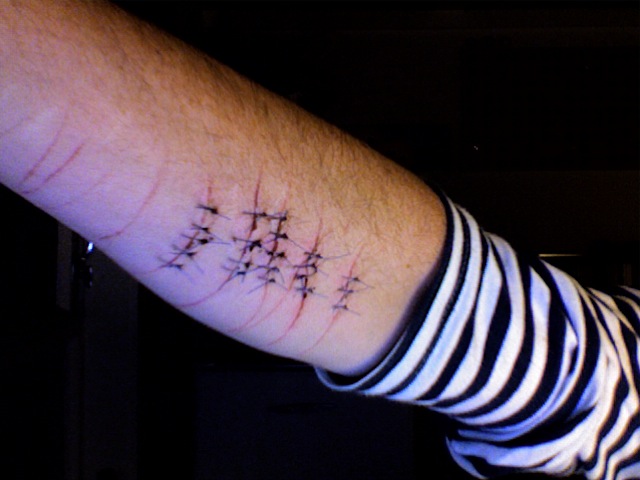
Self Harm/Cutting/Scarification...

On the surface of it, to any sane and normal person, the thought of taking a knife, or a heated piece of metal and mutilating one's own body must seem like madness. Let me assure it is quite the opposite, the very opposite off madness. Madness denotes something that is out of ones own control, being out of control, out of ones mind, other, away from oneself. Self harm/cutting/branding etc is about control and is, in my own experience carried out by people not only in their right mind, but by people controlling not only there minds but their bodies and at  times their very lives, for often the other option is suicide, which in itself is also the ultimate act of control over ones own life and body. Let me make a point here, and let me make it clear...I am not in  any way glorifying self mutilation, for want of a better term, psychiatrists are still trying to come up with some nicer academic term....and there is nothing heroic or admirable about taking a knife and slicing your own skin, your own muscle, but it is a reality and often it is survival. Like Anorexics who try to control their minds and bodies by controlling the amount of food they will or wont allow themselves to abide, people who self harm control their emotions and their world by the amount of pain they inflict upon themselves. Pain becomes a way of regulating emotions. Anxiety (that pathetic term for what in reality is living hell), deep depression, suicidal thoughts, all these are stroked away and dispelled with a swift self inflicted wound. It sounds insane, but it makes perfect sense to the person doing it. It is a private, guilty, desperate act...but often it is the one thing that makes the world make sense.


So who does this 'awful' thing. Sad, self pitying Goths? Attention seeking spoiled teenagers (more of this later), anorexic type body conscious want to be skinny models, angry youths, lonely housewives in an out of control world, spoiled rock stars, high flying execs bored of sex and cocaine, normal men and women who have no other outlet for their emotions, priests, nurses, teachers, bus drivers, shop assistants, hard men, soft men, closeted homosexuals, religious fanatics...all of these and more of course. In short normal folk like you and me.


You would be surprised. A word about attention seeking behaviour...after spending a whole weekend cutting myself repeatedly and trying to dress and clean the wounds for the next week, in order that no one else would find out about what I had done to myself, and after my arm had swollen to twice it's size and was obviously badly infected,  I reluctantly went to my G.P. for help. I had a fever, was out of my mind with pain and of course was sent to A and E...After a doctor had cleaned and dressed my wounds, and set me aside for "Psychiatric Assessment", a young nurse came to ask some questions...one of the first things she said to me was "Attention seeking at your age....etc" I had nothing to say in reply, I wanted to leave but wasn't allowed as I was deemed a danger to myself. I can see why, but that nurses words were the most damaging thing in the whole episode....


So where does this leave us? Obviously self harm, like any extremes of behaviour needs to be addressed and dealt with. There is lots of help out there and reaching out is always the first step...but like a lot of things in this life, there's more to it than meets the eye, and I wonder about all those 'normal' folks out there who cover themselves in tattoo's and piercings. Is there that much off a difference between all these kinds of behaviours?
We make sense of our lives and emotions in many varied and individual ways. To judge one against the other, the normal as opposed the abnormal? I believe that takes us into the realm of prejudice, ignorance and alienation. I hope that anyone who reads this who is struggling with any kind of emotional dilemma finds the strength to reach out and get the help they deserve. This is not meant to shock in anyway, it's life, and life is sometimes raw and complicated, but that doesn't mean it can't be beautiful and simple in the end...


Tuesday, July 19, 2011

Oz Covers at Felix Dennis

This truly magnificent collection of OZ magazine covers is a must for the discerning '60's chic radical. They would make great christmas, birthday, christening, bereavement, invitation etc...cards. Send them to your local police constable today and brighten up their day, or just look at them and marvel at the sheer creativity that went into much loved paper of yore...click the link and enjoy the revolution... http://www.felixdennis.com/gallery/oz-covers/


Enhanced by Zemanta

Talking Pictures...It's a kind of Bonzo Dog Band Documentary


Dazzling, surreal, audacious, brave, stupendous, hilarious, frightening, bizarre, goonish, catchy, childish, handsome, ugly, technicolour DADA...a few words to put in a sentence about The Bonzo Dog Band for your English homework. Still Britain's second greatest pop band off all time, and you can take that to the bank, but they wont give you money for it. Don't believe me, watch this rarefied collection of true British eccentricity in full speed ahead action painting, action man, action lights, action cameras, action music... Action. They are The Beatles on laughing gas, I think.


Enhanced by Zemanta

Sunday, March 20, 2011

Sweet Essence of Giraffe...Viv Stanshall at 68

Victor Anthony Stanshall, known as Viv or Vivian for most of his adult life, was born in Shillingford, Oxford on March 21st 1943. The story goes that after his birth the nurse brought three babies into his mothers room, two with small, neat heads and one with a huge head wearing a shock of wild ginger hair. His mother tried for one of the other babies, but there was no getting away from Vivian.

Viv and his mother lived in Shillingford while her husband, Victor (1909–1990) (a name he had adopted in preference to his own christened name of Vivian), served in the RAF.  Vivian wolud later tell his wife, that this was the happiest time of his life. When the war ended, his father returned, and with him the happiness came to an end.The family moved back to Walthamstow. The return of Victor Stanshall was a turning point in the young Vivian's life. With only him and his mother, life was ideal. With the addition of a stern, pretentious father, Stanshall's life took a serious downturn, followed by a further shock at the arrival of a new brother, Mark Stanshall, born in 1949. They were six years apart, an age difference that apparently put a certain amount of emotional distance in their relationship that was never resolved.

As a teenager, Stanshall secretly joined a gang of teddy boys, attracted both by the rock'n'roll and the clothing. Even among such dandies, though, he was a bit of an oddball. About this time, the Stanshall family moved to the Essex coastal town of Leigh-on-Sea. To put aside enough money to get himself through art school (his father having refused to fund such goings-on), Stanshall spent a year in the merchant navy, where he made a very bad waiter, but a great teller of tall tales. He enrolled at the Central School of Art in London. Here, Stanshall and his fellow students, including Rodney Slater, Roger Ruskin Spear and Neil Innes, who was studying art at Goldsmiths College, came together to form a band.

The Bonzo Dog Dooh-Dah Band
The name of the band came from a word game which Stanshall played with art school peer and future Bonzo member Rodney Slater, involving cutting up sentences and juxtaposing the fragments to form new ones. One of the combinations that came out of this exercise was "Bonzo Dog/Dada". The band initially performed under this name, but soon grew tired of explaining what Dada meant. Thus they became the Bonzo Dog Doo-Dah Band — later abbreviated to The Bonzo Dog Band, or just The Bonzos.

In these early days they were a very loose assemblage, consisting of the core members mentioned above, plus just about anyone else who felt like joining in. At times there were as many as 30 of them, with gigs often featuring more people on stage than in the audience. Their act at this time consisted of anarchic re-workings of old British novelty songs, found on 78 rpm records bought from flea markets, spiced with improvisation and a variety of bizarre machines assembled from junk, with at least one explosion per gig.

The Bonzos might have continued in this way, probably disappearing into obscurity, had it not been for a nasty shock: the 1966 chart success of a winsomely arch number called Winchester Cathedral by The New Vaudeville Band — a band comprising session musicians created by songwriter Geoff Stephens, whose musical style was uncannily like the Bonzos' own. As soon as the record became a hit, Stephens and his record company needed a band to present themselves as The New Vaudeville Band. Bob Kerr, a Bonzo member, was asked by his friend Stephens to become the band, and he tried convincing the others that they change their name to achieve greater commercial success, but the advice was rejected...at this point Kerr left the band. Several weeks later, the band appeared on Top Of The Pops performing the songs in clothes exactly like the Bonzos. An emergency meeting was called and the band decided to wear whatever they wanted. The Bonzos realized that if they were to make a mark for themselves, they would have to forge a new path.

According to the band's manager Gerry Bron (brother of the actress Eleanor Bron), Vivian Stanshall was given several weeks to produce songs for the new professional Bonzo Dog Band. When people arrived at his studio they found he had not written a single thing, focusing instead on building a variety of rabbit hutches.

"Canyons of Your Mind" on Colour Me Pop

From here on, they started writing their own material and dropping it into the act alongside the old novelty numbers. With Stanshall now liberated from his original role as tuba player and firmly established as the front man, the act became more sophisticated, more daring, satirical, and original.  For a while the band existed as a semi-pro outfit playing the college circuit, but it wasn't long before they acquired a manager, went full time, and found themselves booked on the working men's club circuit mainly in the north of England. The band dominated their lives, traveling to low-paying gigs in an old van crammed with any number of musical instruments, an assortment of props, and prop robots.

In 1967, they appeared in The Beatles' Magical Mystery Tour television special playing Vivian's song "Death Cab for Cutie" during the strip club scene, and this was followed by a slot as the house band on Do Not Adjust Your Set, a weekly TV revue show essentially for children, also notable for early appearances by David Jason and various future Monty Pythons.

The Bonzos on "Do Not Adjust Your Set"


In 1968 the Bonzos scored a surprise top ten hit with a number called "I'm the Urban Spaceman" (produced by Apollo C. Vermouth aka Paul McCartney), after management wanted them to "play the game" as Innes put it, to try for a hit single. The band toured incessantly and recorded several albums, which led to a tour of the United States. This was so successful that they were booked for another US tour soon after. Neil Innes remembers that the band were reportedly stopped by a local U.S. sheriff and asked if they were carrying any firearms or drugs. When they denied both, the officer asked how they were going to defend themselves. Vivian piped up from the back of the minibus, "With good manners!"

Between the tours, however, something brought about a change in Stanshall's personality. There were rumours of a bad acid trip in the States, but Vivian never confirmed nor denied this, instead explaining it as a panic on stage which destroyed his confidence and inevitably his life. None of his fellow Bonzos claims to know just what happened, but by the start of the second tour he was taking very large doses of tranquillizers prescribed by a private doctor ostensibly to treat stage-fright, which in reality was crippling agoraphobia and panic disorder. This led also to Vivians increasingly large in take of alcohol in order to self medicate himself for the symptoms of his illness. Nevertheless, the workload never let up. The band had a punishing schedule, often playing more than one gig per evening. The band got sick of the whole touring scene, and decided to split still as friends. In 1970, after six years of mounting exhaustion, they broke up.

Post Bonzos and the Emergence of Sir Henry Rawlinson...
Stanshall went on to form various short-lived groups including The Sean Head Showband, Bonzo Dog Freaks (featuring the guitar talents of the rotund Bubs White) and BiG GrunT. At one point, he even went into teaching art and drama at a boys' secondary modern school in Surrey. By now, his life was dogged by alcoholism and panic attacks, which he tried to control with Valium; he would have these problems for the rest of his life. He had several spells in hospitals in attempts to stop or control his drinking, but they never worked. He was also still being prescribed larger and larger doses of Valium, which, he later reported, made things worse by adding another addiction. Even so, he continued to write music and tour. 

The Rawlinson family had been populating Stanshall's imagination for quite a while, their first appearance (in name, at least) being on the Bonzos' 1967 number The Intro & The Outro: "Great to hear the Rawlinsons on trombone".

An LP, "Sir Henry at Rawlinson End", which reworked some of the material from the Peel sessions, appeared in 1978. A sepia-tinted black and white film version, starring Trevor Howard as Sir Henry, and Stanshall as Hubert, followed in 1980. It was also based on the Peel recordings, with many variations from the LP. Some of the film's music was provided by Stanshall's friend Steve Winwood. A book of the same title by Stanshall, illustrated with stills from the film, was published by Eel Pie Publishing in 1980. Nominally a film novelisation, it was distilled from all the various versions of the story, including a good deal of material that was not used in the film.

A second Rawlinson album, "Sir Henry at Ndidi's Kraal" (1983), recounts Sir Henry's disastrous African expedition, but omits the rest of the Rawlinson clan. According to Ki Longfellow-Stanshall, his widow, he regarded this recording as sub-standard and it was released without his knowledge and against his wishes. He was ill when making it, and the record company issued it as quickly as possible. Stanshall was often drunk and/or depressed during production, which took place on The Searchlight, a house boat he bought from Moody Blues and Wings' Denny Laine and moored between Shepperton and Chertsey on the River Thames. He lived on it from 1977 to 1983. Converted from a Second World War era submarine-chaser, it was forever taking on water and sank with all his possessions aboard. Almost all of them were retrieved, some the worse for water damage.


After Sir Henry and So To The Big Sleep... 
Stanshall collaborated on numerous projects including Robert Calvert's Captain Lockheed and the Starfighters, Mike Oldfield's Tubular Bells where he is the Master of Ceremonies, breathily announcing the buildup of instruments in the finale of the first side of the album, appeared with Grimms and The Rutles, as well as occasionally working with The Alberts and The Temperance Seven.

While living on the Searchlight, Stanshall composed and recorded Teddy Boys Don't Knit, and wrote and recorded Sir Henry at Rawlinson End. There, he also wrote and filmed the film of the same name for Tony Stratton-Smith's Charisma Records company. At the same time, he co-wrote with Steve Winwood the songs for Winwood's Arc of a Diver and wrote some of the songs he later used for Stinkfoot, a Comic Opera, the musical comedy he wrote with his second wife Ki Longfellow.

After the Searchlight, the Stanshall family lived and worked on the Thekla, a Baltic Trader, which was sailed 732 nautical miles (1,356 km) from the east coast of England to be moored in the Bristol docks. Ki had bought the Thekla in Sunderland, and converted her into a floating theatre called The Old Profanity Showboat. Vivian joined her when the doors opened to the public for the first time in May 1983. In December 1985, the ship saw the debut of their production, Stinkfoot, a Comic Opera.

Stanshall wrote 27 original songs for Stinkfoot, sharing book and lyric writing with his wife. The show involved bizarre characters that they imagined living under a seaside pier as well as characters taken from Longfellow's early tale for children called Stinkfoot. It proved a success, with people coming from all over Europe and even the Americas to see it. It was revived in London some years later with Peter Moss as musical director, but was not a critical success.

"Vivian Stanshall's Week" Documentary


There is also a 28-minute film of Stanshall currently inside the BBC vault: One Man's Week, dated 1975, looks at a week in his life and includes footage of him at The Manor Studio recording studio playing music with Gaspar Lawal, Mongezi Feza, Anthony White and Derek Quinn. This film also shows him talking about his turtles and playing his 'Phonofiddle'.

Stanshall's voice won him several commercial voice-overs, including a campaign for Cadbury's Mini Eggs which involved a reworking of the Bonzos' song Mister Slater's Parrot, under the title of Mister Cadbury's Parrot.

Vivian was married twice: in 1968 to fellow art student Monica Peiser (they had a son, Rupert, that year, and were divorced in 1975); and on 9 September 1980, to novelist Pamela "Ki" Longfellow. They had a daughter, Silky, born on 16 August 1979, named after a racehorse called Silky Sullivan, her mother's childhood favourite.
In late 1988, after Fish had left Marillion, the band considered using lyrics Stanshall had written, but in the end decided to hire John Helmer instead.

In 1989, his short interview with John Wesley Harding was released on Harding's God Made Me Do It: the Christmas EP.

In 1991, Stanshall made a 15-minute autobiographical piece called Vivian Stanshall: The Early Years, aka Crank, for BBC2's The Late Show, in which he confessed to having been terrified of his father, who had always disapproved of him.

A later programme for BBC Radio 4, Vivian Stanshall: Essex Teenager to Renaissance Man (1994) included an interview with his mother in which she insisted that his father had loved him, but Stanshall was mortified that his father had never shown it, not even on his deathbed.

Death
Stanshall was found dead on 6 March 1995, after a fire at his Muswell Hill (north London) flat; coincidentally, this was one hundred years to the day after the death of (the original) Sir Henry Rawlinson. Stanshall often smoked and drank in bed and even set fire to his long ginger beard, to the frequent concern of his wife and friends, however the fire was later attributed to faulty electric wiring.


Enhanced by Zemanta

Thursday, March 17, 2011

Into the Deep: America, Whaling & the World

I can't say enough good stuff about the online PBS website and especially their American Experience series of documentaries. They cover everything from the first white settlers and the impact they had on Native Americans, to the assassination of Abraham Lincoln to The Dustbowl and on and on.

My fascination with the American whaling industry started  a few years ago after watching the movie "Moby Dick" with Gregory Peck in his greatest role as Captain Ahab, and continued with me reading the novel (one of the greatest American novels ever in my humble) of the same name. It's a pity Starbucks had to tarnish this great novel by stealing the name of Ahab's right hand man for their awful chain of rubbish coffee shops. Nothings sacred.

This documentary brings it all home in stunning detail. While I find whaling abhorrent to say the least, this was a different time. I make no case for or against the whalers of this historical period, but their endeavors shaped America for good or ill.

I couldn't embed the documentary, but follow this link and you should be right.
http://video.pbs.org/video/1485863181


Enhanced by Zemanta

Thursday, February 17, 2011

Bikers & Hippies...1960's grimy documentary about modern day outlaw

"As tough as they look, not one of these cat's can cut in modern day society...and they like it like that" So says the verging on the crazed voice over to the intro to this bizarre documentary about the menace that was BIKERS & HIPPIES!!


Bikers, Hippies from Django's Ghost on Vimeo.

Enhanced by Zemanta

Sunday, February 13, 2011

If you want it...The Badfinger Story

They were poised to be the 70's answer to the fab four. Their first hit was a Macca original, they penned the huge pop balled "Without You" later taken to the top by Harry Nillson and Mariah Carey. George Martin, Todd Rungren and George Harrison produced some of their finest work, they had the power pop world at their feet. So you may ask...what happened? The story is stranger and more tragic than you can begin to imagine. Dressed up here in the "Behind the Music" gloss, the story of Badfinger is gripping and poignant none the less...all this and they were Welsh!!


Money/Flying


"Here Cones the Sun". Pete Ham and George Harrison perform at the Concert for Bangladesh..really lovely version...

Monday, January 31, 2011

a conference of birds

A tune i wrote influenced by John Fahey and other country blues musicians. Open tuning G. Bit scratchy but close enough...

Thursday, January 27, 2011

Time

Short film featuring my son with a kite on a beach in winter. Music inspired by Simon & Garfunkel, remixed by me...